ProspectMX is an internet marketing company We introduce companies to the unlimited possibilities of real content marketing and technical SEO for your very real company.
ProspectMX is an internet marketing company We introduce companies to the unlimited possibilities of real content marketing and technical SEO for your very real company.

Our marketing strategies drive results that will greatly improve your bottom line.
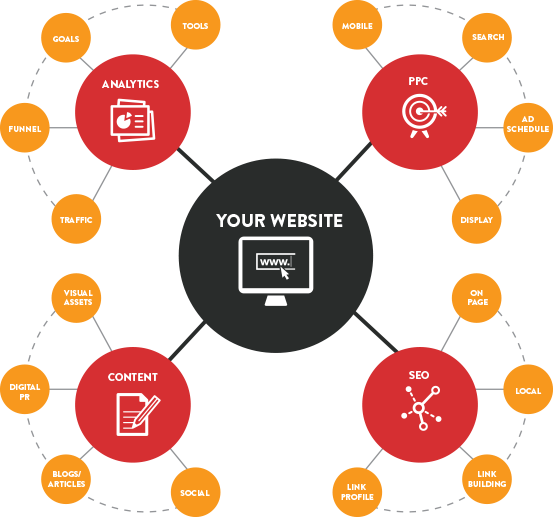
ProspectMX takes a holistic view to any Internet Marketing Campaign Strategy we undertake.
Move your cursor over any of the red circles to the right for more information.
Imagine what your website could do with some strategic attention given to it by our team of experts!
The scientific, data-driving force for why we do what we do. Trackable metrics lead to informed creative decisions and proof of your ROI.
We help you show up for competitive keywords that convert fo your brand and enforce remarketing efforts.
We earn you attention through creating useful and compelling content that supports your industry, brand, and services.
We implement keyword category focused copy and HTML best practices to generate organic traffic from search engines.

"We turned to ProspectMX to help us create industry buzz about a new unified controller that we launched at Pack Expo 2010. The ProspectMX team took the bull by the horns and wasn’t afraid of a good challenge. The results reflected extraordinary work. We owe a great thanks to ProspectMX for helping us create the awareness we needed with over 1000 targeted visitors to our site in a short amount of time."
James Cooper, VP of Sales and Marketing, KUKA North America Kuka Robotics

“ProspectMX improved our brand recognition and company messaging on the web. We now have a site that showcases our services and are now ranking on the first page of Google results for our main keywords and getting leads each and every day.”
Bryan Strickler, President, Strickler Signs Strickler Signs
The world of search will continue to evolve, and the experts at ProspectMX are dedicated to keeping up. As we see the age of personalized search take hold, it’s no longer about ranking #1 for keywords. After all, everyone will see a different set of results!
Instead, internet marketing is about establishing your brand as an authority in your niche, leveraging your social presence, optimizing your local presence, and increasing your search visibility across your web properties. Building trust with your industry, your potential clients, AND the search engines is essential to leveraging the power of the internet to drive greater revenue for your business.

The ProspectMX Team gathered for some training on recent updates to the Google Algorithm and how to strategically navigate our clients through to success.

Let Us Guide Your Inbound Marketing Campaign to Success Out with the old and in with ...

SEO Services In addition to making your content read well and delivering a compelling user experience, ...

Paid Search Services Paid search campaigns remain one of the best ways to get immediate, targeted ...

Analytics Harness the power of Analytics to track audience engagement and conversions, analyze your marketing funnel, ...

About a year ago I was in the market to purchase a new car. I wasn’t going into this process cold. I knew what I wanted, what it was worth, and what I was willing to spend. I was ready ...
Continue Reading
As a book lover, it’s beyond frustrating when people tell me that they don’t like to read. It’s even worse when they dare to insult one or more of my favorite books or series. Anymore, it seems as though there ...
Continue Reading
Can You Write a Decent Blog in One Hour? Let’s Find Out… As marketers, we tell our clients that blogging not only helps them, but that it’s one of the keys to success. We give you tips, tricks, topics, and everything you ...
Continue Reading