Breaking It Down: How Content Marketing Benefits Your Business

Trying to explain WHAT content marketing is, let alone how it can benefit a business, can be a challenging endeavor.

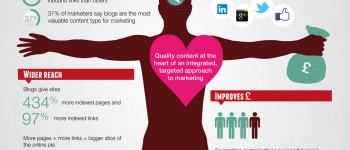
Courtesy of ContentPLUS

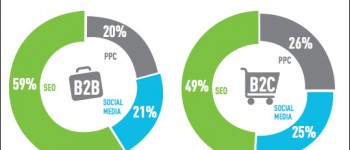
Courtesy of ContentPLUS

Most business minds, from CEOs to marketing managers, are stuck in the mindset that all marketing should directly generate leads/sales, or at least directly impact your bottom line…especially when it comes to online advertising.  They’re hesitant to spend money on things that are more for branding then direct revenue generation.

At least, this has been true of smaller businesses in my experience.  Most big brands understand the importance of branding – after all, it’s usually one of the ways they became a “big name” in the first place.

Content marketing is all about building a name for yourself online, spreading your brand, and become an internet superstar in online communities.

The Fact Of The Matter Is…

I think anyone who knows anything about internet marketing can agree on two facts:

  1. With very few exceptions, just about every business (both b2b and b2c) can benefit in some way from internet marketing.  In fact, businesses who haven’t made an effort to include online advertising in their marketing budget are cutting themselves off at the knees.
  2. There’s already a TON of content on the web – and most of it isn’t very good.  Gone are the days where new content you post gets noticed easily because now there’s just too much of it.  Your content has to offer something pretty spectacular to get noticed.

Content marketing is about creating an awesome piece of content, whether a whitepaper, viral blog post, infographic, contest, or video, and promoting it online via social sharing and blogger outreach.  It can be useful content chock full of stats, something comical to make people laugh, something heart-warming to get their attention, or some tool that fulfills a need.

It’s most often used as both a branding and SEO tool to improve your visibility online.  (There are other definitions of content marketing, but for now the focus is on viral content marketing).

What businesses need to understand is that the audience you’re creating viral content for is NOT necessarily your segment of prospective customers.  They may be a secondary target, but not the primary.

The main audiences of most viral content are the communities of people on the web who love to spread, share, link to, and talk about cool content pieces, videos, apps, programs, etc.  These are the social media power users, the shareaholics, and the “linkerati” as our friends over at SEOMoz call them.

Your prospective customer base is your secondary audience – anyone who might need your products or services, or could potentially become a strategic business relationship.  However, if you’re in a smaller industry, there are not always easily identifiable, prominent web communities for your industry to which you can promote your content.

Occasionally, rarely, in the right industry with the right content piece, they do overlap…and when that happens, whoever created and promoted the content gets lifelong bragging rights!

So What Is Content Marketing Good For?

Just because a piece of content that’s gone viral doesn’t generate leads or sales on your website does NOT make it a wasted venture.  Instead, the success of a content piece should be measured in:

  • The number of visitors your content piece receives, and whether a traffic spike is evident in your site analytics during the implementation and promotion of the piece.
  • The number of backlinks the page on which your content piece is posted receives.
  • The number of Shares, Likes, Pins, Tweets, etc. your content piece ends up with.
  • Whether your website eventually starts ranking for keywords related to your content.
  • Any major media mentions you receive thanks to your amazing content.

There are other ways to measure the success of your content marketing campaign – these are simply the most obvious.

So what’s in it for your business?  Well, your business and your website can benefit in several ways from content marketing:

  1. The SEO effect – viral content tends to generate tons of social mentions (increasing your site’s “social signal authority” to the search engines) and backlinks to help increase your organic rankings.
  2. The traffic effect – as the content spreads, people are visiting your site on a regular basis, increasing your direct, referral, and organic traffic.
  3. The branding effect – your brand becomes a more famous name online as people notice your content and start remarking on it, helping to build you into a household name.
  4. The sales effect – as the above effects take hold over time, you’ll see an increase in relevant traffic to your site, which typically equals more leads or sales for your company!

I was going to end the post with one or two awesome infographics about content marketing – but  last year, Joe Pulizzi over at ContentMarketingInstitute.com already put together a post compiling some of the best content marketing infographics on the planet (his words, not mine).

0 Comments

Tips For Preparing Your E-Store For International Customers

Want to take your website global but not sure where the best ecommerce markets are or how to attract international customers?

Below, in this infographic published by Brokers Worldwide – an international provider of mail services – you’ll find a list of tips and tricks for attracting international customers to your site.

With shopping cart abandonment at an all time high and international e-retail markets exploding you don’t want to take that first step toward going global before “checking out” these secrets to beating your competition:

Oh – and if you do want to download a PDF copy of the infographic, click here.

0 Comments

4 Ways To Integrate Your Marketing Strategy

There is one goal for your marketing campaigns: generate revenue either through sales or brand awareness that leads to future sales. However, your ability to effectively maximize your profits from investments in social media, e-mail, PPC campaigns, SEO, and blogging hinges on your ability to integrate all of these tools into a focused, cohesive strategy that uses each channel to build up the other. Here are 5 tips on how to develop an integrated marketing strategy.

integrate email and social media

Integrate E-mail with Social Media

An e-mail campaign is an effective way to directly connect with customers. When your promotion lands in customers’ inboxes, you have their attention since they most likely signed up for your list expecting something valuable. If you create something they want, then it stands to reason that you need to provide simple ways for customers to share your e-mail campaign on social media.

Many e-mail marketing programs offer options to share a campaign on Facebook and Twitter, but don’t forget to include social media calls to action within the body of your e-mail message such as “Share this message now…” DJ Waldow at the Social Media Examiner suggests adding incentives, such as a prize, discount, or publicity for those who share your campaign on social media.

Integrate Blog Posts with E-mail, Social Media, and PPC

As you work on creating effective PPC campaigns that attract customers to your blog by targeting keyword phrases, make sure you send these visitors to a relevant landing page on your blog that will drive conversions such as sales, blog subscribers, newsletter subscribers, and social media shares. When you’re organizing a campaign to promote a product, you’ll certainly want to write a lot of content on your blog in support of it, but when you’re linking to your site from a PPC campaign, the landing page should be specially tailored for those visitors.

A good landing page, according to Corey Eridon at HubSpot, should offer clear value to customers, include sharing buttons, minimal links to other parts of your website, and provide clear calls to action.” At the bottom of your landing page, consider adding additional links to related posts on your blog, such as the E-mail Marketing landing page at Copy Blogger. In addition, you can evaluate your conversion rates in order to find which keywords are most effective on your blog and then write more content related to those keywords in order to boost yourself in that niche. Sarah Goliger of HubSpot writes, “You should be paying less attention to volume metrics (like number of clicks and number of impressions) and more attention to performance metrics like cost-per-click (CPC), cost-per-acquisition (CPA), and conversion rate. These will show you how well each of your keywords and ad groups is doing for the amount of money you’re spending.”

Integrate Your Blog with Social Media

Share your blog posts automatically and set up additional shares so that your top content gets more exposure. Your blog is a powerful tool to increase engagement with your customers. Zach Hofer-Shall writes for Forrester Research, “too many companies have siloed data practices, keeping marketing and business data on one side of the organization and social media data on another. But as I often say – if you only listen to social media, you only learn about social media. To get the most out of marketing to your customers, you must integrate it with other data.  Leveraging data and making use of both 1st and 3rd party data to tailor content appropriate to you audience will drive more viewers to your blog.”

Integrate Your E-mail Marketing

Coordinate your e-mail marketing efforts. According to HubSpot, there are many different kinds of e-mails your marketing team could be sending out, such as “automated emails to blog email subscribers and leads who have been entered into a lead nurturing campaign, weekly/monthly newsletters highlighting your top content, or individual dedicated sends just to promote your new offers.” You need to know who is receiving which e-mail and where your various leads are in the process. The key to successfully nurturing leads is to collect demographic data. HubSpot is particularly effective at this and offers a 10-point list of what you need to collect, such as job title, role at company, and pages viewed. With better data in hand, you can effectively funnel your leads to the correct e-mail marketing list and build relationships with customers.

This guest post is written by Lior Levin, a marketing consultant for a company that offers a variety of Pre shipment inspections, and who also consults for a psd to html online company.

0 Comments

Is Your Business Being Found?

Due to the ever evolving world of technology, people are looking to the internet to find business recommendations locally. Businesses that appear in the local search results are found on several online business listings. Submitting your business online can help with your companies search engine optimization. So don’t wait to be found! Submit your business information to get listed on some of the free directories including:

Google Places

As the number one search engine, it’s critical that your business has a local search page. In doing so, your business can be found and you can physically verify your information. Google also allows your business to stand out among the crowd. You can make the public aware of what types of products and services you offer and upload photos, videos, current offerings and more. The best part? You can get insightful information about your listing and make sure you’re making wise businesses decisions moving forward.

Bing Local

Bing Local allows your business to appear in the results when users are looking or are near your location. Bing Local gives you the opportunity to improve or update your business listing at any time. If you have more than one business location you can manage those listings as well. A thorough verification process further enables you to protect your account and authorize your changes.

Yahoo!

Yahoo! Local listing permits you to customize your business listing by selecting a basic or enhanced profile that is easy to manage. The basic option lets you display your business contact information, store hours along with your products and services and it’s free! With the enhanced feature, you will have everything the basic listing includes in addition to your business logo and tagline, photos, and a detailed business description.

Yelp

Yelp allows every business owner or manager to setup an account to post products and services, hours of operation, offerings, photos and even message their customers. Users can rate and provide comments on your business as well as forward the listing to a friend for more information. You also have access to see who your competitors might be of those viewers who viewed your listing.

Best of the Web Local

Best of the Web Local allows you to provide your business contact information including website and email as well as driving directions, photographs and payment options. BOTW Local Premium offers you more visibility and detailed information that can ultimately drive greater foot traffic to your location.

It’s important to keep in mind there are a slew of other online business listings that must be completed to really make an impact and get your business found.

0 Comments

15 Ways the Internet Changed Marketing

Of all the inventions in the last 50 years, few have changed the world as much as the Internet.  Destroying mail, books, television and dignity, life has changed much thanks to our electronic friend.  Here are 15 ways, for better or for worse, the Internet has changed marketing.
(more…)

4 Comments